The cross-border checkout problem no one talks about
April 20, 2026
Getting someone to your website is hard. You've earned their attention, their intent, and a product in their basket. Cross-border checkout is where that investment can silently fall apart and most merchants aren't treating it seriously enough.
Getting someone to your website is hard. You've invested in the ad, the SEO, the product page, the brand. You've earned their attention and, at some point, their intent. They've put something in their basket. And then, at the very last moment, before you have their money, they're gone.
For most merchants, this is an uncomfortable reality that rarely gets investigated seriously. Our research, conducted with Sapio Research across 1,000 US and UK retail and SaaS decision-makers, found that 19% of businesses consider checkout a purely technical issue and 15% treat it as an afterthought altogether. That's roughly one in three merchants who don't think about checkout as a commercial lever.
The data suggests they should.
Checkout is already under pressure. Cross-border makes it worse.
56% of merchants in our research say checkout negatively impacts their cross-border transactions, manifesting as abandoned carts, low approval rates, failed payments, and poor shopper experiences. The Baymard Institute puts average cart abandonment across ecommerce at roughly 70%, and that challenge only compounds internationally, where duties, taxes, currency, and delivery timelines add friction at every step.
The redirect problem is where a lot of that friction originates. 32% of merchants in our research identified redirects to separate checkout pages as one of their biggest problems. They're right to flag it.
Why redirects are a cross-border trust problem specifically
When a merchant uses a traditional merchant of record (MoR) solution to handle cross-border sales, the MoR becomes the merchant of record on the transaction. The payment legally flows through them, not through the merchant. To make that work technically, the shopper has to complete the purchase on the MoR's infrastructure, which typically means leaving the merchant's storefront entirely and landing on a checkout page the MoR controls.
So a shopper who has spent time building trust with your brand suddenly finds themselves on a different page. Different URL, different design, sometimes a different language treatment or currency display - the thread of continuity snaps.
For a cross-border shopper it's worse, because they're already in a heightened state of vigilance. They're buying from a foreign site, potentially in a non-native currency, already asking themselves whether this is trustworthy. The redirect confirms their suspicion that something is off.
Merchants also lose visibility and control at exactly the moment that matters most. You can't A/B test the checkout. You can't apply your branding. You can't surface local payment methods the MoR doesn't support. You've handed off the most commercially sensitive moment in the customer journey to a third party whose checkout is optimized for their operational needs, not yours.
And it shows up in the numbers. A checkout experience that breaks continuity doesn't just cost you the shopper's confidence. It costs you approval rates too. Every handoff between environments is an opportunity for the transaction to fail technically, for the payment to be flagged, for the flow to time out. The merchants who treat checkout as infrastructure rather than afterthought tend to see better approval rates cross-border, not just better conversion, because fewer things go wrong between intent and completed transaction.
Local payment methods are a related failure point. 21% of merchants report their checkout doesn't support the payment options their international customers actually use. Stripe's data shows that businesses offering additional locally relevant payment methods saw an average 7.4% increase in conversion in 2024, with some markets seeing far larger gains. That conversion lift doesn't require a product change, a rebrand, or a new market strategy - it requires the right infrastructure at checkout.
The cost of getting this wrong compounds
Here's the thing that makes checkout friction particularly brutal: every other investment you've made in that customer becomes waste the moment they leave. The CAC, the creative, the platform spend, the fulfilment capacity you've built for cross-border volume. A shopper who abandons at checkout isn't just a lost transaction. They represent the full cost of acquisition with zero return.
And yet, when merchants describe their checkout experience, only 33% would call it "the experience customers dream of." 55% describe it as something that "gets the job done." That is a remarkably low bar for what is, functionally, the most commercially critical moment in a merchant's relationship with a customer.
The infrastructure argument
Most merchant of record solutions solve the cross-border compliance problem by taking over the checkout. You get their payment flow, their redirects, their branded experience sitting between you and your customer. The liability shifts, but so does the control, and you've just recreated the exact trust and continuity problem you were trying to solve.
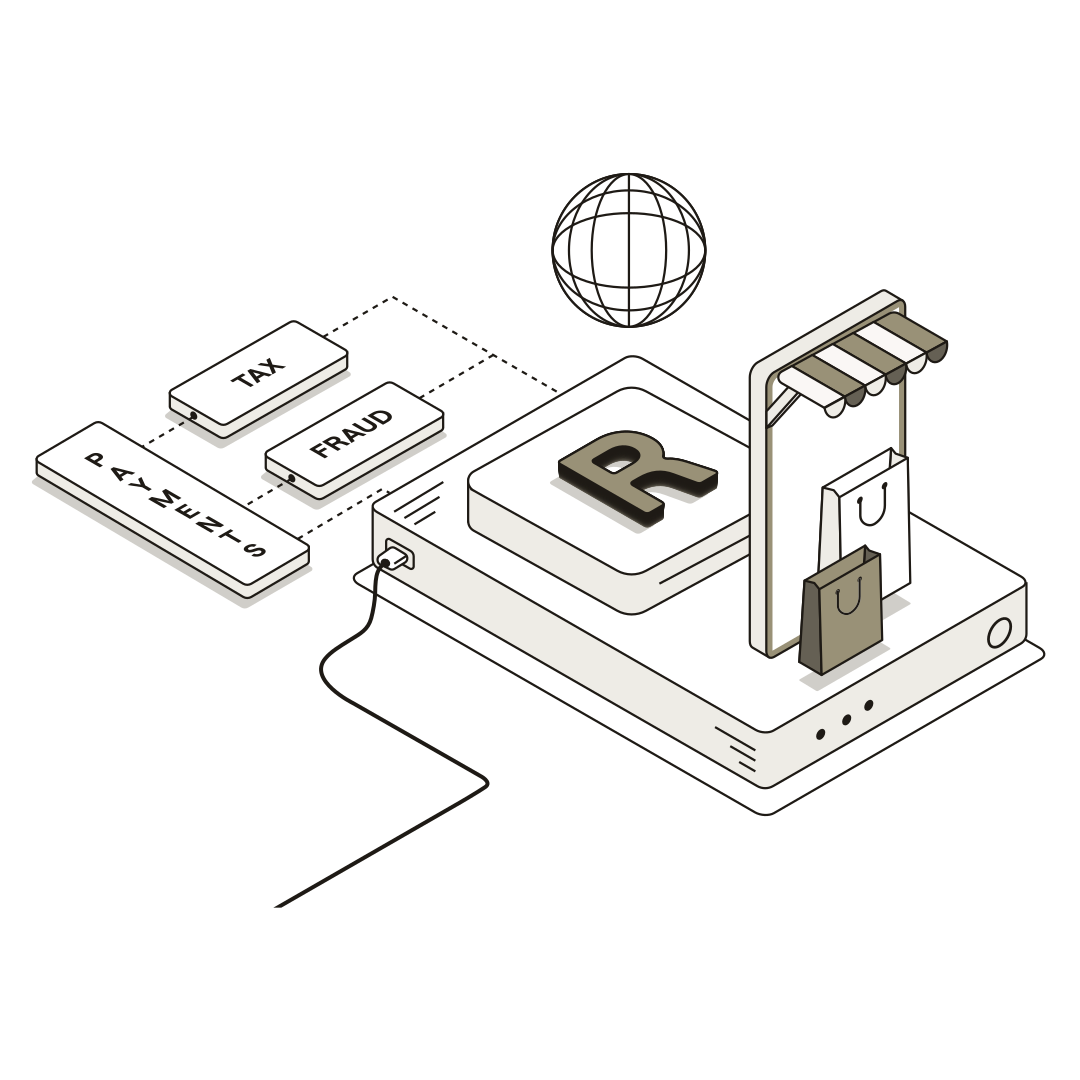
What cross-border checkout actually needs is infrastructure that runs underneath your existing setup. Something that handles localization, compliance, and payment routing without displacing the experience you've built. You keep your branding, your UX, your provider relationships. The complexity doesn't go away. It moves somewhere you don't have to see it, because it's being handled properly at the infrastructure layer.
30% of merchants say they can't customize or brand their checkout flow. 21% can't show accurate shipping and duties information at the point of purchase. These are solvable problems. They're just not solvable by handing your checkout to someone else.
Cross-border commerce has moved from edge case to core channel for most ambitious merchants. The checkout experience that serves a domestic customer reasonably well will fail an international one in ways that are hard to see until the conversion data arrives. By then, the cost is already real.
More efficient global sales in just a few weeks
Book a call to see your fastest path to efficient international sales. We'll walk through exactly how to add 70+ countries to your checkout without rebuilding anything.


